+ 01 / Intro

AlnylamAlnylamSSOT
Lead Time Dashboard · sketch v1 · day-one war room
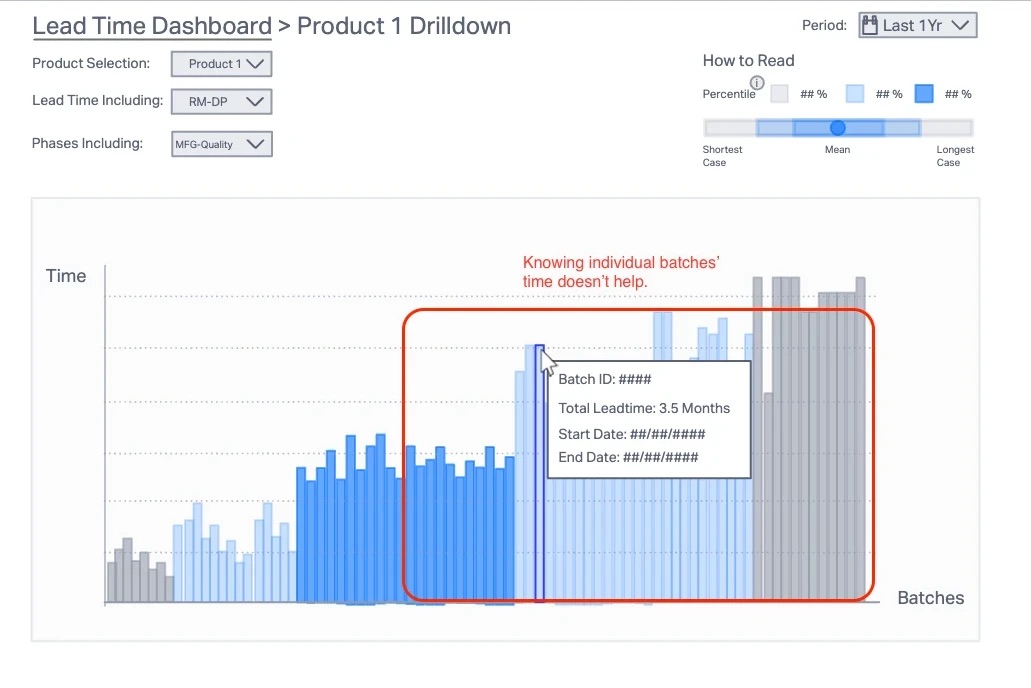
Lead Time Dashboard wireframe with red SME annotation reading 'Knowing individual batches' time doesn't help'
SME annotation in red — “Knowing individual batches’ time doesn’t help.”

Sketches as catalysts, not artifacts. The wrong one made the right one obvious.

Role
Senior IC
Timeline
8 weeks fixed → engagement expanded
Impact
Shipped · +690% YoY client revenue · 4 follow-on engagements

+ The constraint

02

Two months. Fixed budget.
A platform the client was about to bet a lot on.

Alnylam’s SSOT consolidates program data scattered across R&D, Clinical, and Launch into one platform. Discovery couldn’t run long. Stakeholder groups were using the same words (“milestone,” “phase”) to mean different things, and a workshop or two wasn’t going to surface it. Traditional UX rhythm would have caught the misalignment three weeks before launch — too late.

THE FOUR CONSTRAINTS THAT RULED OUT TRADITIONAL PROCESS

8 wksFixed timeline · zero buffer · no recoverable slip room
FixedBudget locked at contract · scope creep forbidden
3+Stakeholder groups · overlapping vocab, different mental models
HighStakes · clinical-trial timelines downstream of the platform

The choice wasn’t between fast and slow. It was between what surfaces misalignment fastest. Discovery interviews surface stated preferences. Workshops surface group consensus. Neither surfaces what a stakeholder actually believes about a specific data view until they see one and react to it. So the method had to start at the artifact.

+ In practice

03

The annotations
ARE the spec.

Four sketches from the eight weeks. Each one carries the SME reaction it provoked, still on the page. The case study doesn’t have to describe the method — it’s drawn in the margins.

Lead Time Dashboard sketch with red annotation: 'Knowing individual batches' time doesn't help'
SKETCH 01 · LEAD TIME

Wrong altitude.

Per-batch granularity drowned the signal. SME annotation in red: “Knowing individual batches’ time doesn’t help.” Spec: cut the per-batch view, ship a phase-level rollup.
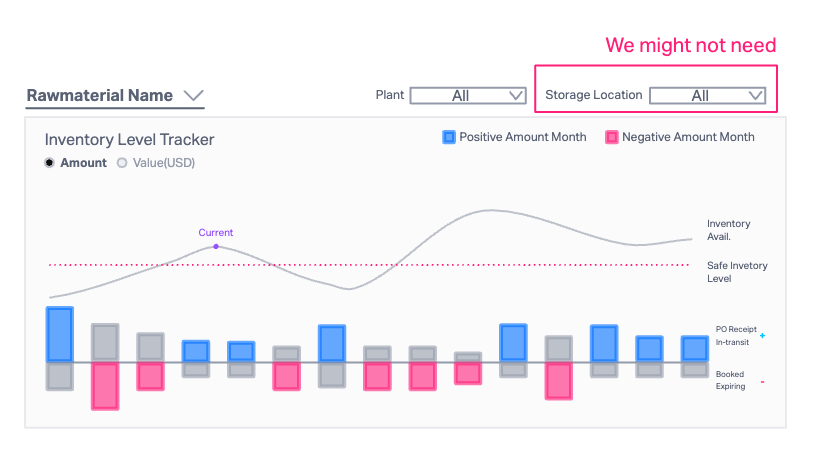
Inventory Level Tracker sketch with pink-box annotation on the Storage Location filter: 'We might not need'
SKETCH 02 · INVENTORY LEVEL

Wrong scope.

A Storage Location filter was drawn in. Pink-box reaction: “We might not need.” Spec: cut the dropdown, simplify the chrome.
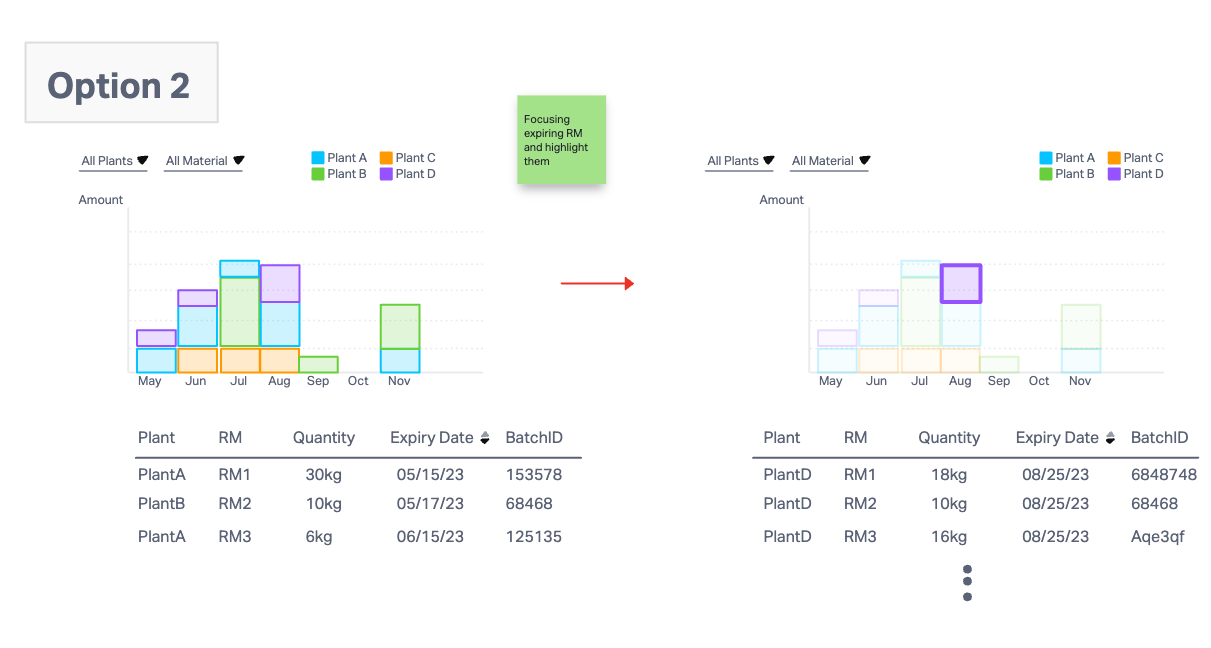
Option 2 stacked-bar sketch with green sticky note: 'Focusing expiring RM and highlight them'
SKETCH 03 · OPTION 2

Wrong emphasis.

Equal-weight stacked bars buried urgent batches. Green sticky: “Focusing expiring RM and highlight them.” Spec: dim non-expiring, emphasize expiring.
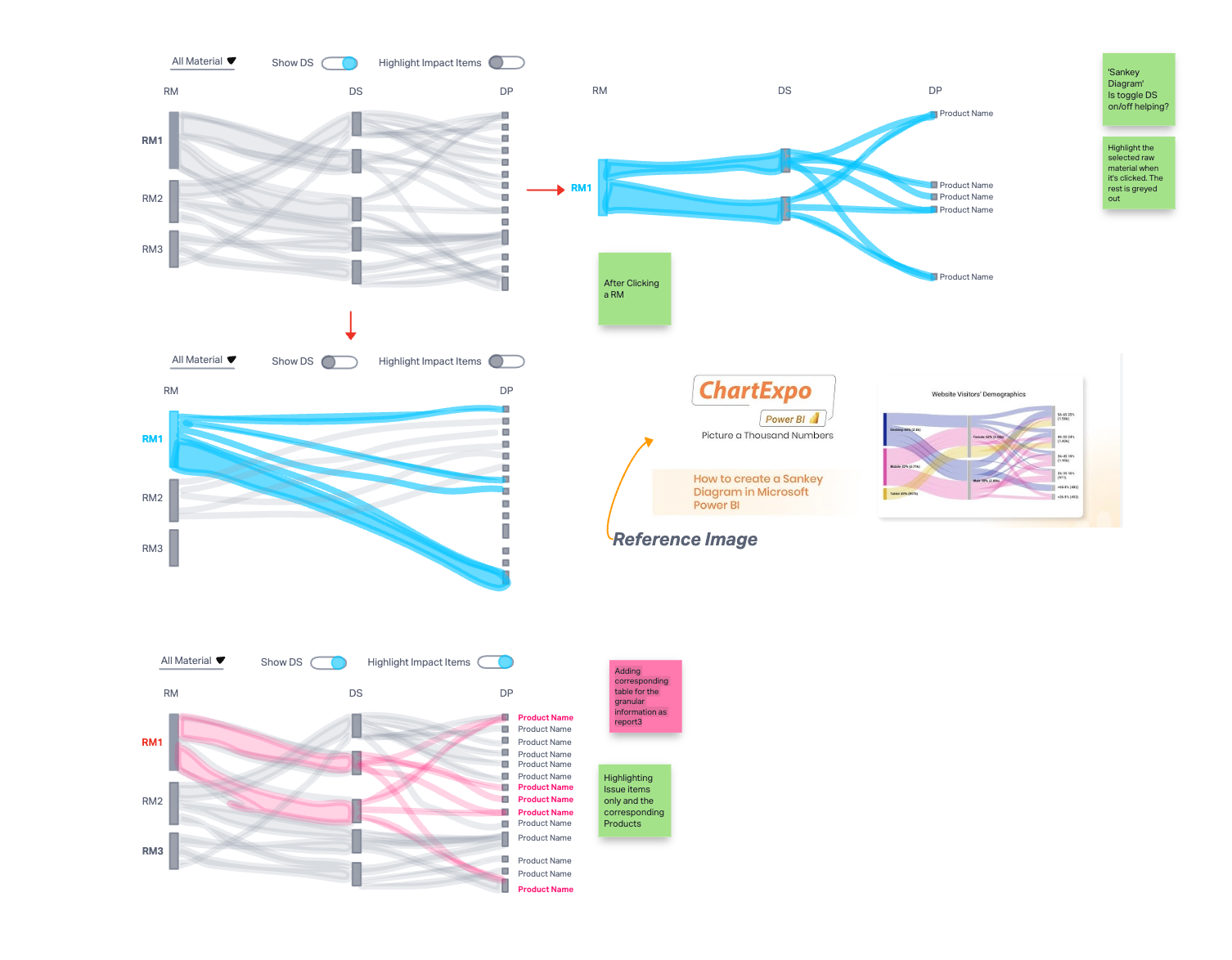
Three Sankey-diagram explorations on a single canvas with multi-color sticky-note annotations
SKETCH 04 · SANKEY EXPLORATIONS

The sketch is the conversation.

Three Sankey options on one canvas, sticky-notes everywhere. No deck. No write-up. Spec: the meeting is the artifact.

↑ Annotation = spec. No translation step. ↑

Every sketch went out at end-of-day with annotations on it. Every morning started with the next version of the same sketch.

+ The outcome

04

Eight weeks in.
The engagement expanded.

The hard constraint wasn’t a ceiling on the project — it was a floor for trust. Velocity at fixed scope was the proof. The expansion came not from a single deliverable, but from a cadence the client decided to keep buying.

RECEIPT — WHAT THE ENGAGEMENT RETURNED

Client revenue growth YoY
690%
Client revenue growth YoY
Highest growth on this client in 5 yrs
5 yrs
Highest growth on this client in 5 yrs
Additional engagements signed
4
Additional engagements signed
More pharma initiatives followed
3
More pharma initiatives followed
01 / PROJECT EXPANSION

A proof-of-concept the client kept buying.

  • Led directly to 4 additional engagements to scale digital transformation
  • Positioned the SSOT as a proof-of-concept for broader platformization
  • Client gained confidence in what could be achieved within severe limitations
02 / DIRECT REVENUE

Cadence-driven trust → top-line growth.

  • Revenue from the client grew 690% compared to the previous year
  • Marked the highest growth in 5 years across this account
  • Trust built on velocity, not deliverable polish
03 / PERSONAL BRAND

Sector-specific demand established.

  • Became a trusted design lead in Life Sciences and Healthcare initiatives
  • Pulled into 3 more pharma initiatives right after this engagement
  • Method generalized into a Life-Sciences-track playbook

+ Reflection

05

Where this method
earns its place.

Wrong-on-purpose works when the room is smart, the constraint is hard, and the cost of mid-flight misalignment is high. It fails when stakeholders won’t catch the mistake — then you’ve just shipped wrong work.

TWO TAKEAWAYS

WHERE THE METHOD TRAVELS

WORKS

  • Senior cross-functional rooms
  • Time-boxed engagements
  • Regulated industries (pharma, finance, healthcare)
  • Late-stage product correction

FAILS

  • Early-stage clients without domain depth
  • Junior stakeholders — wrong-on-purpose costs reputation without information
  • Low-stakes UX
  • Async-only teams (no daily review surface)