
Where is the audience already concentrated? Show up there.
Both projects had real audiences, but those audiences were concentrated in completely different geometries. POMEs’ audience was 60 people sharing physical walls. VoltHop’s was thousands of folding e-bike owners scattered across continents but converging in specific online rooms. The motion has to match the geometry — anything else is wasted effort.
~60 people concentrated in a single building. Everyone in the same physical place, every day.
Thousands of folding e-bike owners scattered globally — but congregating in a handful of online rooms.
Same framework, different geometry.
You can’t scatter a leaflet in r/Brompton, and a Reddit thread won’t fit inside a Greenpoint elevator. The two motions are not interchangeable — they’re answers to different geometries of the same question.
I leafletted 9 buildings with my wife. 95 of 97 signups came from elevators.
Targeting
- Audited 60+ buildings across 4 NYC neighborhoods — LIC, Williamsburg, Greenpoint, Downtown Brooklyn.
- Four filters: 80+ units, doorman or hybrid concierge, renter-heavy resident mix, multi- elevator core.
- Nine buildings made the leafletting shortlist; three Greenpoint towers carried the result.
Execution · methodology
Each phase produced one artifact. The diagram below is the actual sequence I ran across three weeks — leaflet → first email → app follow-up → in-building monitoring.
FIG. 2 · FOUR-PHASE GTM PROCESS
- 01
Leaflet
QR · 4 surfaces tested
- 02
First email
after the scan
- 03
App follow-up
live link in the same thread
- 04
Move in · monitor
watch the interactions land
Execution · in the field
Designed the leaflet, tested four surfaces.
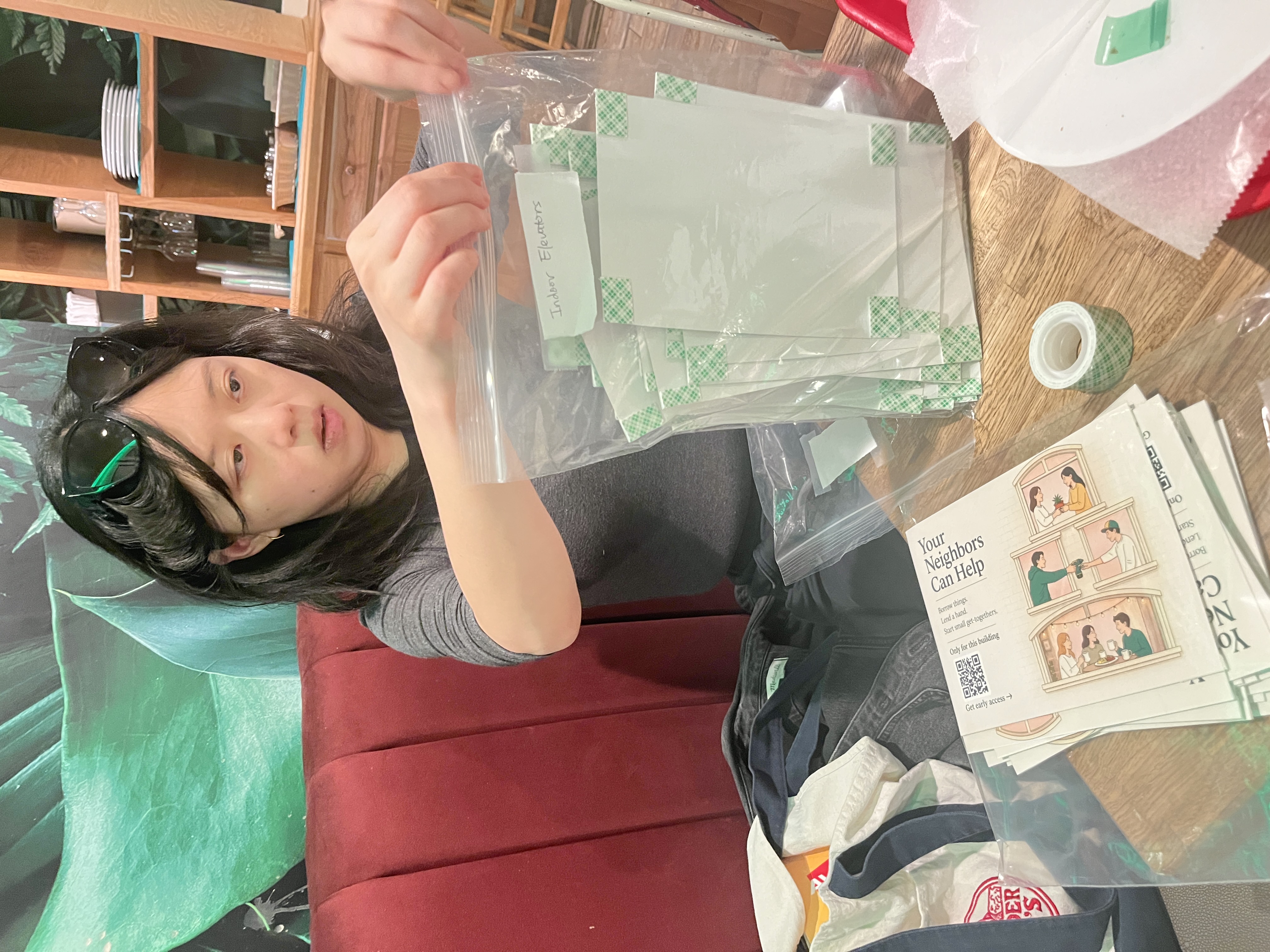
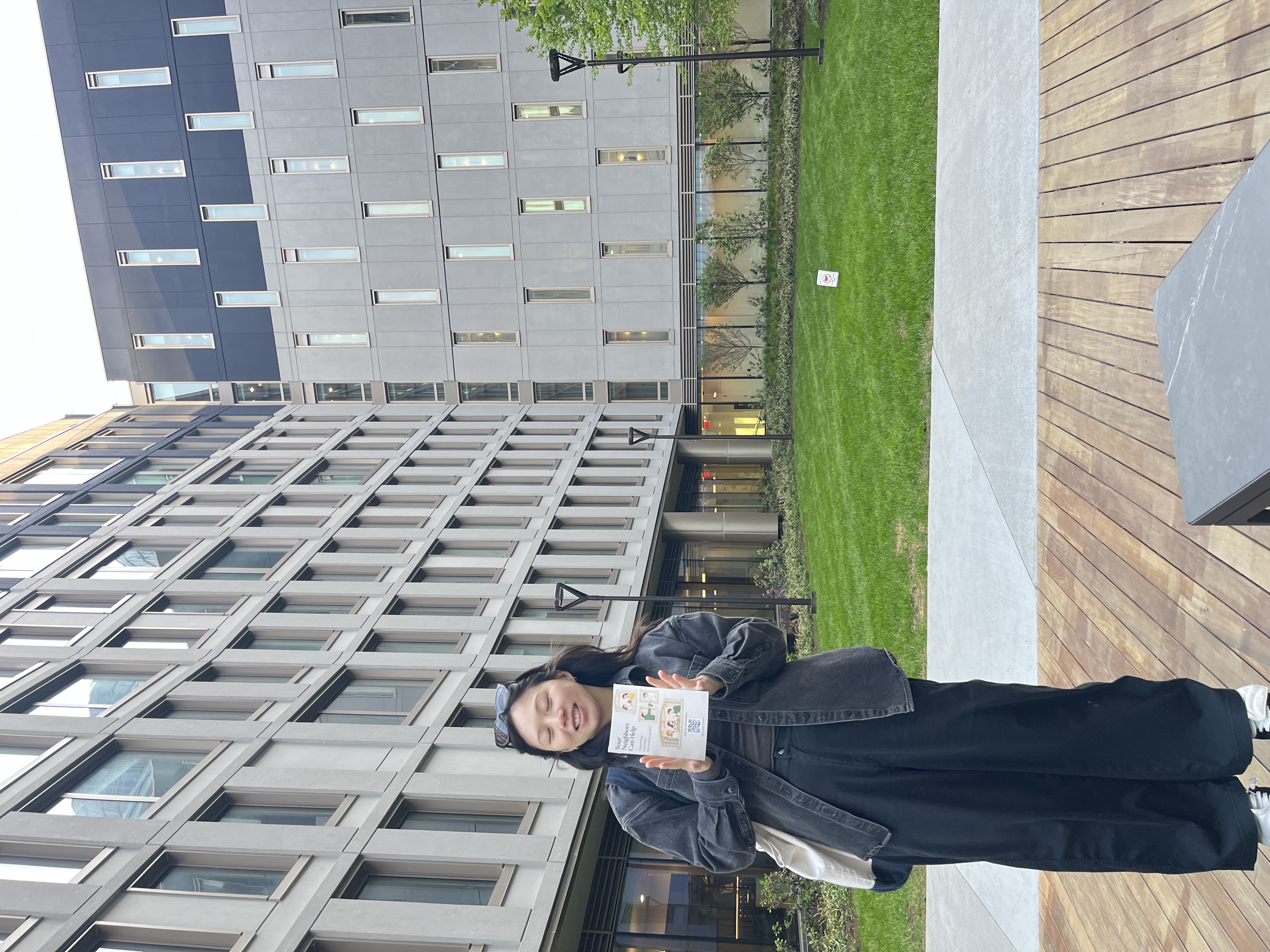
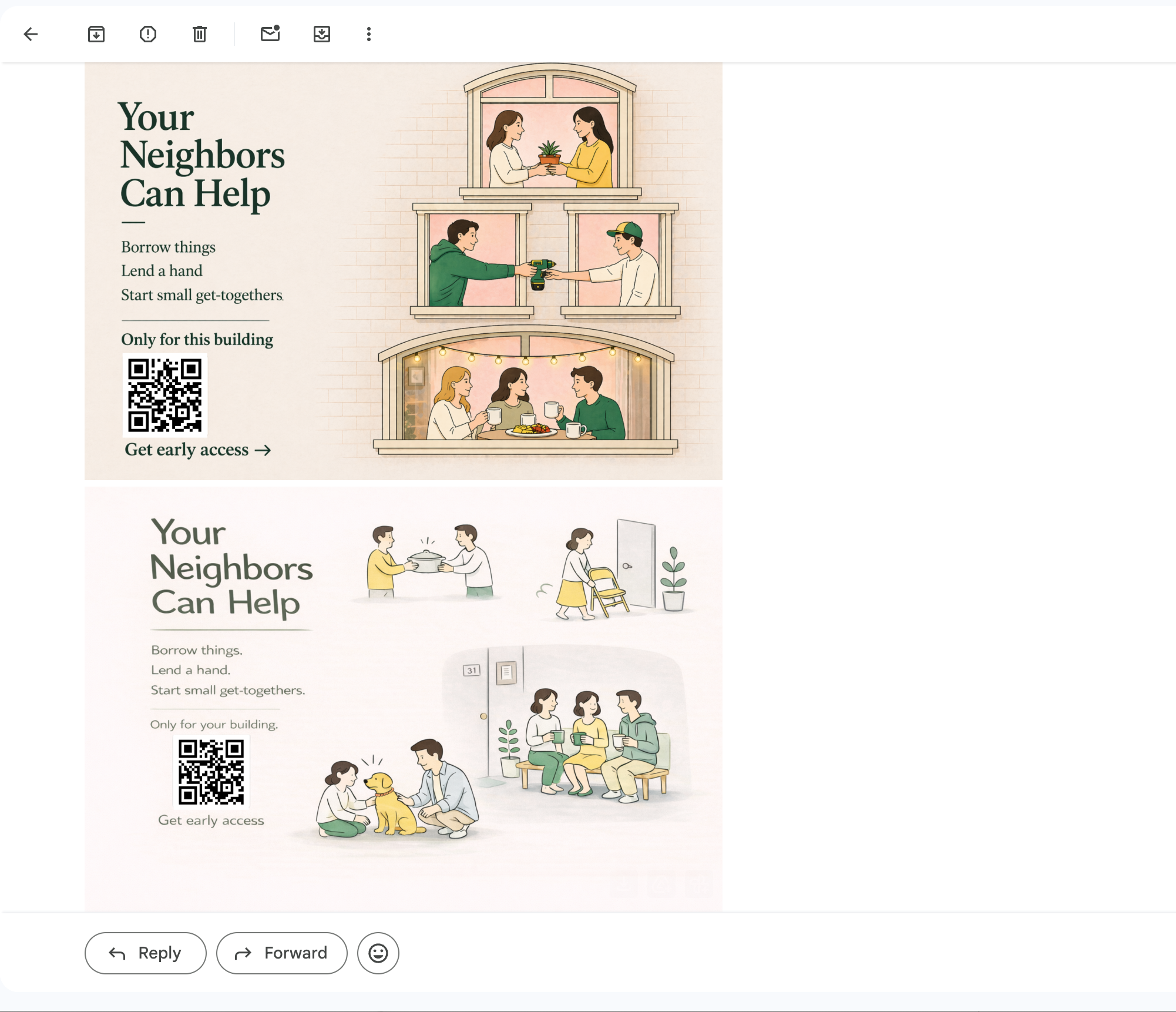
Designed a QR-leaflet with the problem statement and a single ask. Tested it against four placement surfaces — elevators, lobbies, mailrooms/laundry, local cafés — to learn which surface earned the scan. Verdict: elevator. The 30-second captive window beat every other surface.
Scanned → first email.
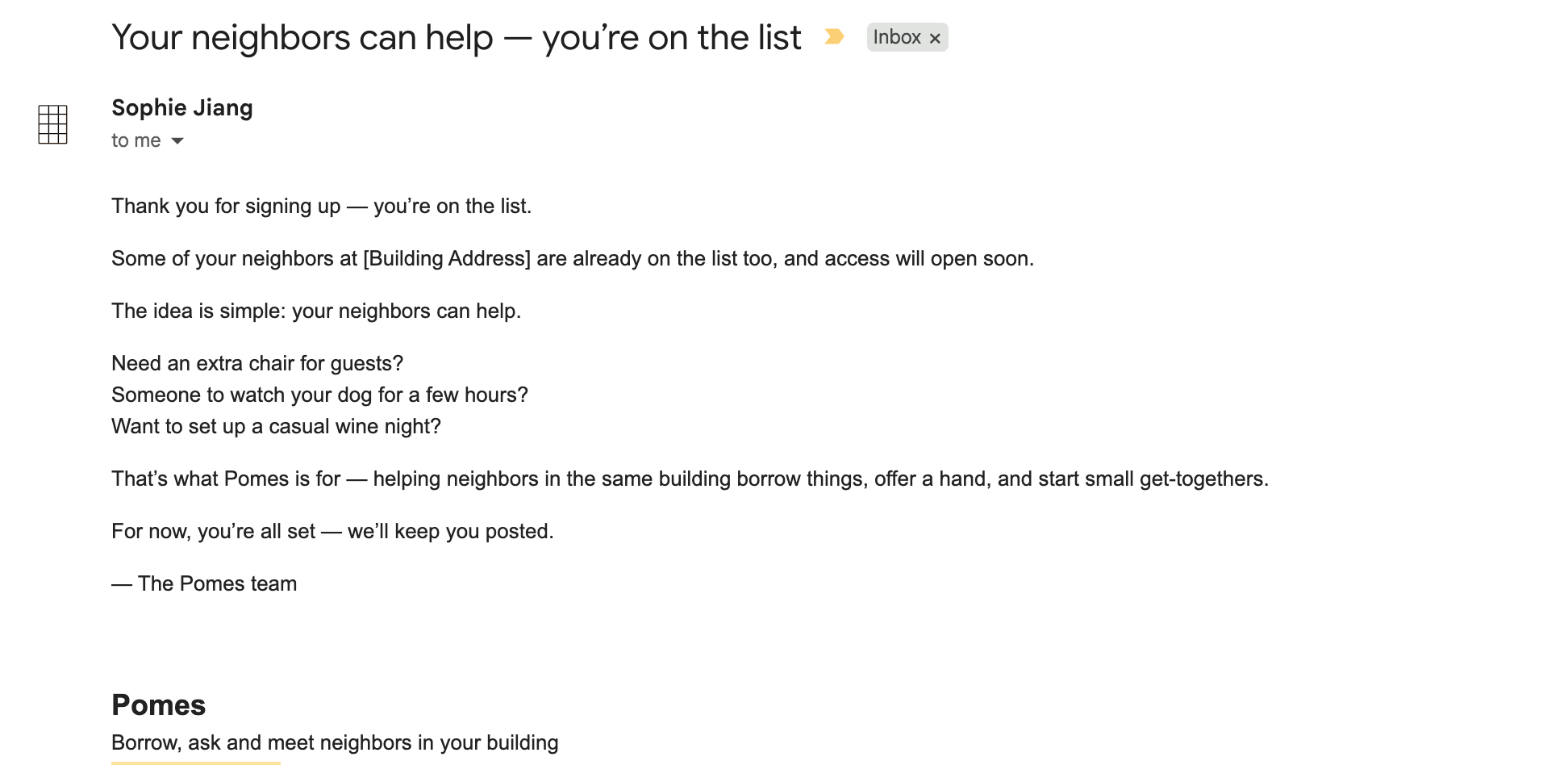
Every QR scan went to a one-field form. The address (apt + building) seeded a quick first email that read like a neighbor, not a campaign — same building, same problem, here's what we're building.
App ready → second email with the live link.
Once the app was live on TestFlight + Play, the second email landed in the same thread — the people who had said 'this would be useful' got the install link, in their inbox, in their building.
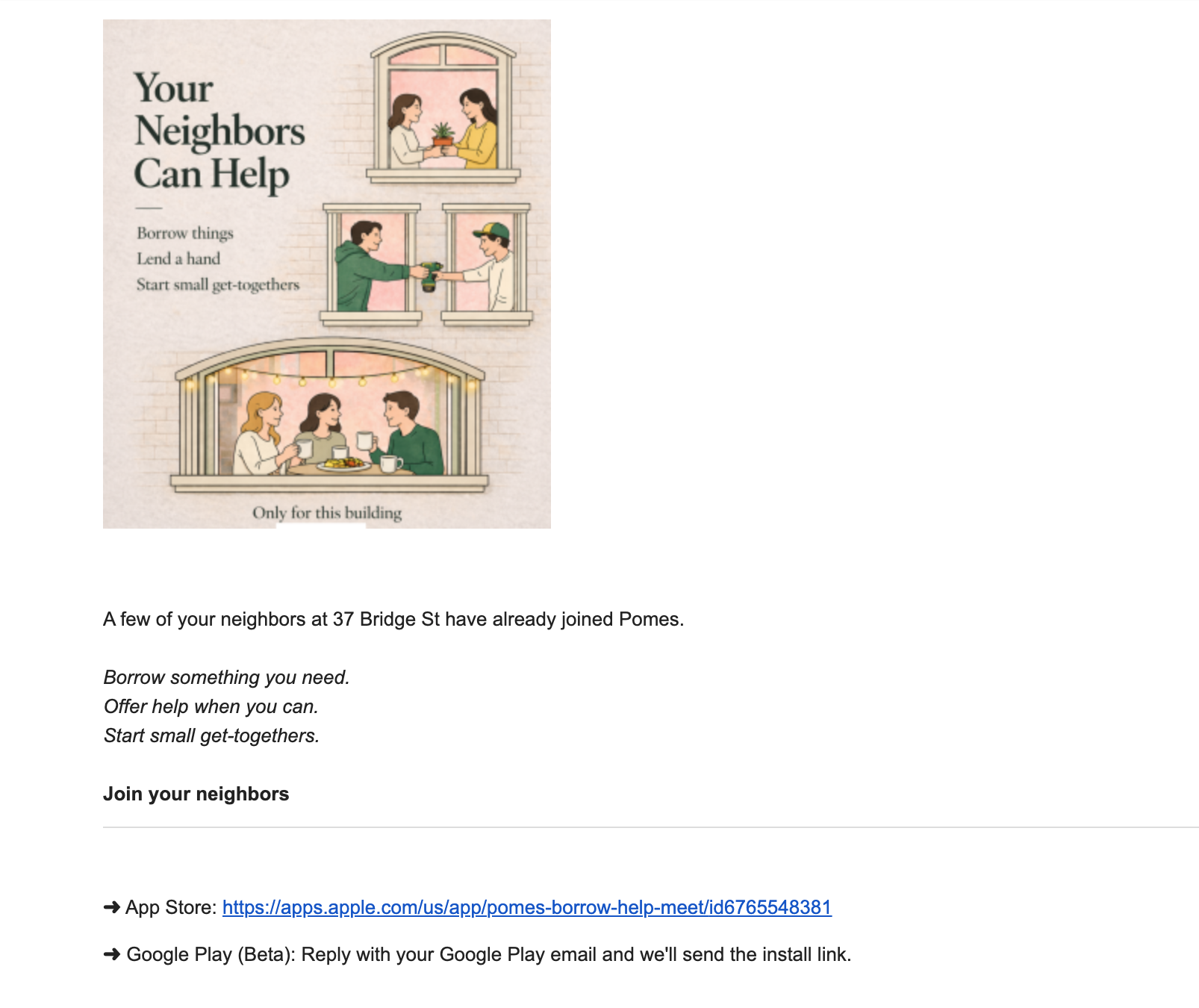
Moved in, monitored, watched the interactions grow.
I leased a unit in the highest-converting building and watched the early signups discover each other — first borrows, first favors, first event RSVPs. Joining the building was the only way to read the interactions the analytics couldn't.
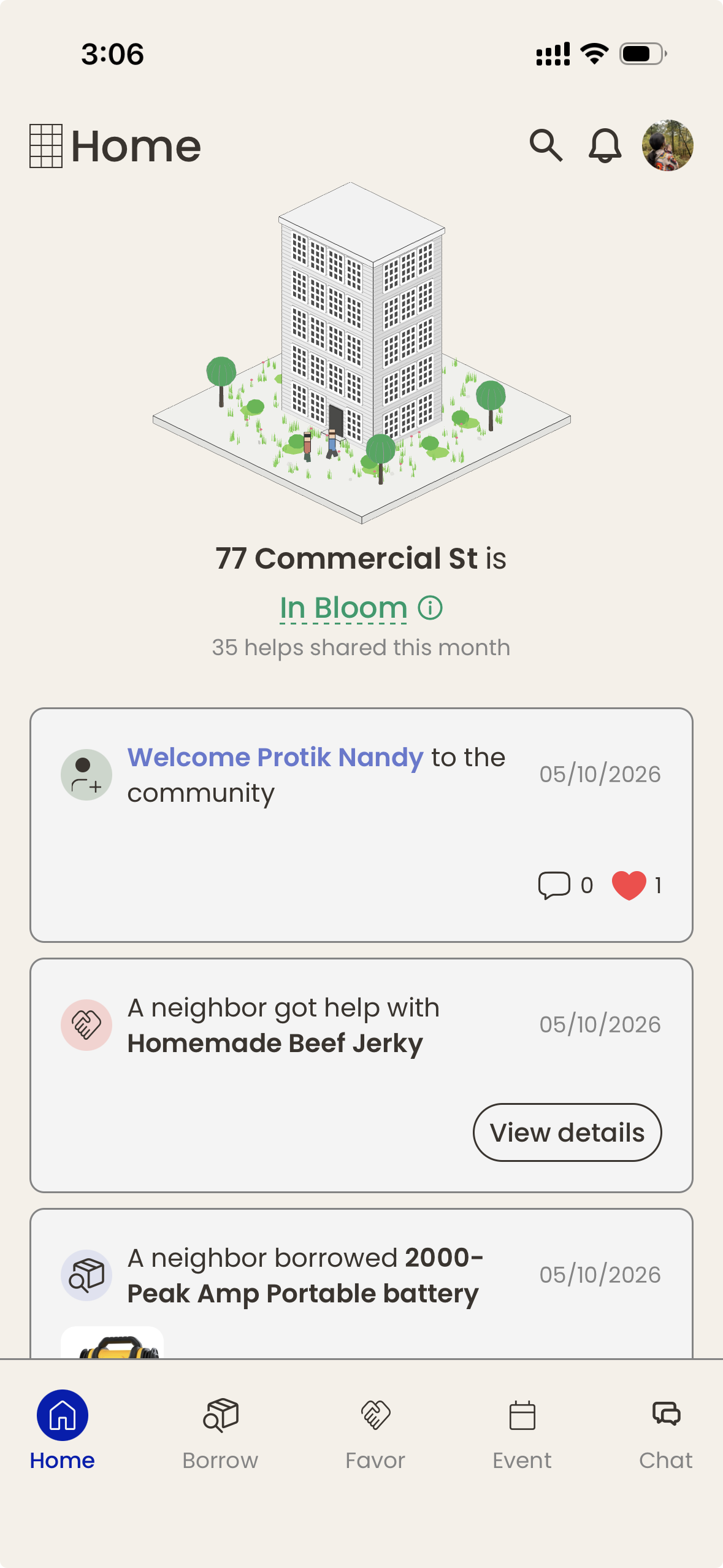
Result · Greenpoint owned every meaningful conversion.
95 of 97 conversions came from elevators. Not lobbies. Not mailrooms. Not the QR card I tucked into package-room shelves. People are alone, captive, and bored for thirty seconds in an elevator — that’s the QR scan window.
Full POMEs case study — neighborhood selection, building audit, design pivot → POMEs page
Lower views, fewer comments — but vastly more useful engagement.
For VoltHop, the audience wasn’t in a building — it was in a handful of digital rooms. I started by posting the same problem-framing question in r/ebikes (broad, ~430K members) and r/Brompton (niche, ~12K). The numbers said broad won. The conversation said the opposite.
Phase 1 — the same post in two rooms.
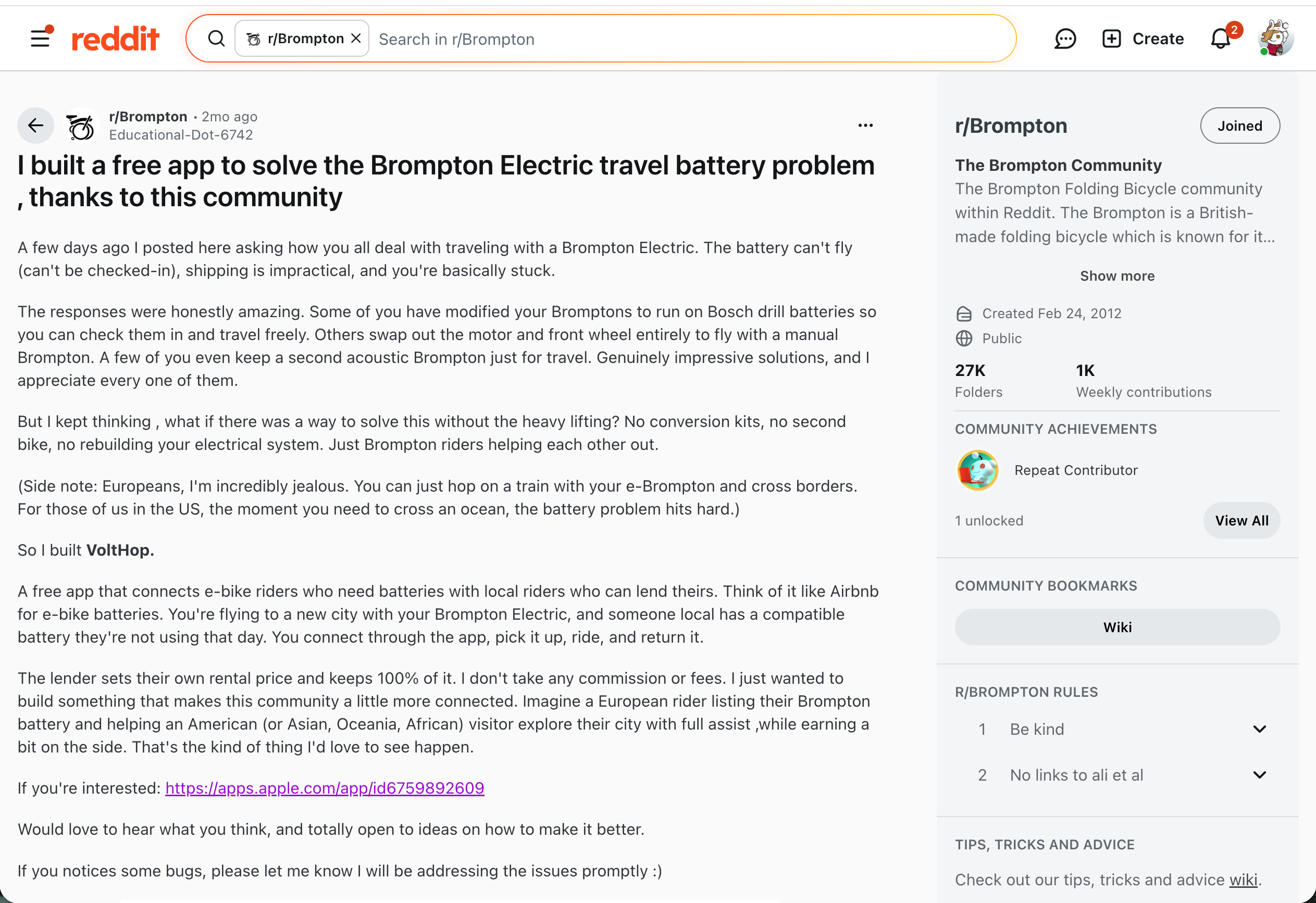
"Just rent at the destination."
Engagement was wide and shallow. Riders treated the e-bike as a generic transportation tool — most fixes pointed to rental kiosks or workarounds.
"My Brompton has to come with me."
A third the views, but the comments were product-shaping. Owners shared exact battery-handling rituals and what a rental partner would need to do.
Lower views, fewer comments — but vastly more useful engagement. Brompton owners gave me product-shaping feedback. r/ebikes gave me workarounds. The lesson: niche communities with deeper attachment are worth more than broad communities with surface-level interest.
What four owners actually said.
“Maybe we could invent Air BnBattery.”
→ A user coined the product name three months before I did. The wedge was real before I built it.
“Brompton announced a rental scheme years ago and it never shipped — there's a market here that the company has just left on the table.”
→ The category had an official-yet-stalled solution; that's where unofficial alternatives win.
“A battery hire option would be great — the battery is the only thing I can't easily fly with.”
→ Pinpointed the friction at the airport, not at the destination.
“Brompton should've solved this by now.”
→ A Top 1% community contributor confirming the gap from inside the audience.
Where else the audience actually was.
The Reddit signal pointed me to four Facebook groups where Brompton and Tern riders share travel logistics, parts, and ride photos. Three are active; one is the cautionary tale. The replies below are real comments from real owners — pulled directly from the outreach threads.
Brompton Electric Owners
ACTIVEBrompton enthusiasts who own the e-Brompton — the bullseye audience.
Stefani Lange
“Oh this is exactly the gap I keep running into when I travel to see family — would love to test it.”
→ Brompton Electric Owners reposted to the original launch thread; Anne Bennett comment is still pending a follow-up.
Brompton G Line Society
LIVE · MULTI-LANGUAGE SWEEPFlagship G Line community. English post live; DE/FR/NL/IT/ES/PT variants drafted for the EU sweep.
—
“Posted on 2026-04-28 as part of the European Outreach Sweep — engagement collected against language-localized variants per country.”
→ Logged in Marketing Reactions DB. Sweep is the test for whether localized posts outperform a single English launch.
Tern Folding Bike Club
ACTIVE · CROSS-BRAND REPLYAdjacent folder community — not Brompton, but the same airport-battery problem and the same workarounds.
Rick Park
“I've shipped my battery via UPS Ground a couple times — works but it's a hassle. Something like VoltHop would honestly save me a chunk of the trip prep.”
→ Tern reply was the first cross-brand validation — the problem isn't Brompton-specific. Approved + scheduled.
FIIDO e-bike fans
LOW SIGNALLower-end folder community. Posted same template; zero comments after two weeks.
—
“Zero replies. Strategy review queued — likely the audience here owns one battery and never travels with the bike, so the rental wedge doesn't apply.”
→ Kept in the case study because the absence of signal IS the signal — niche-global only works in rooms where the friction is felt.
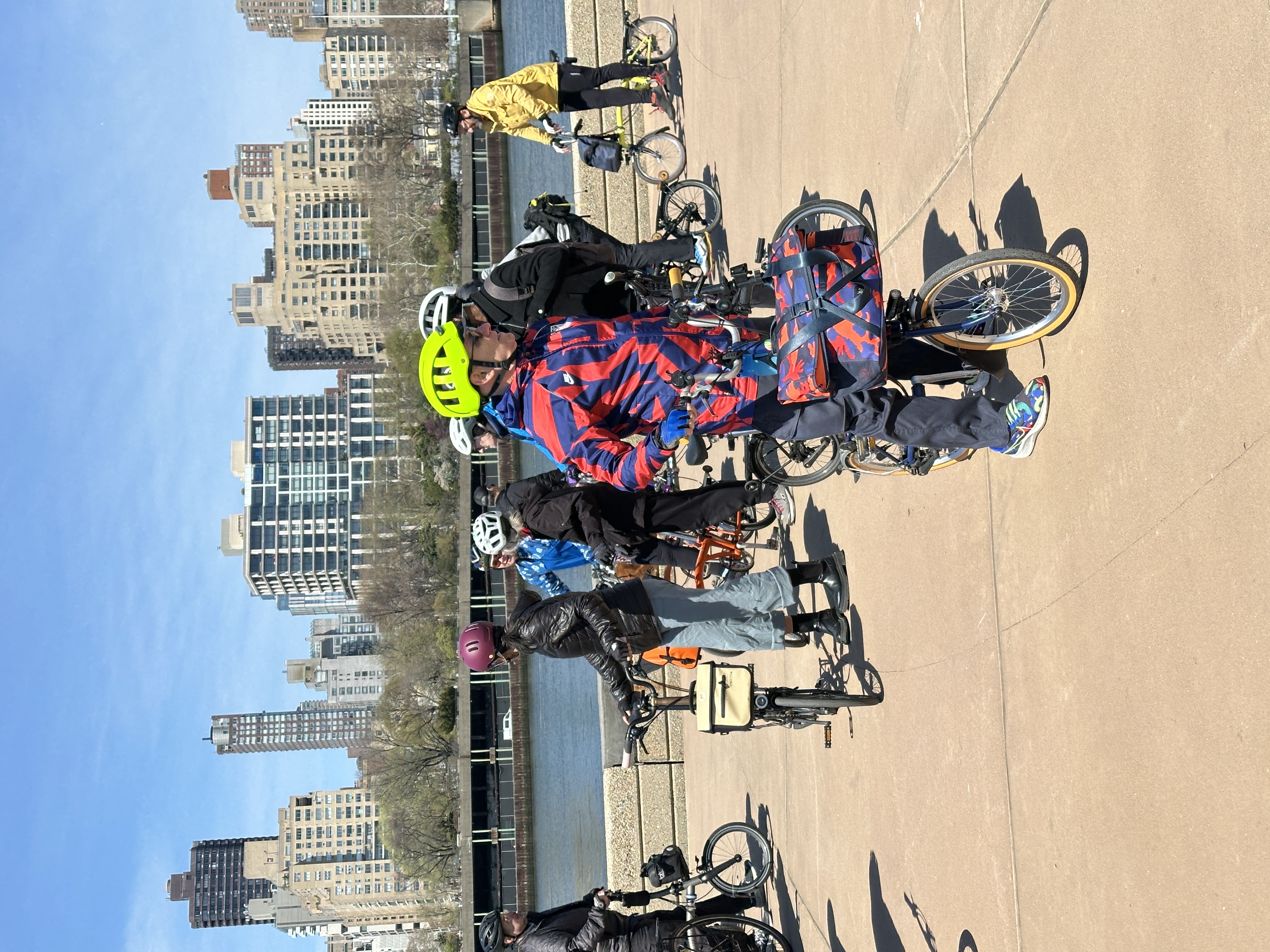
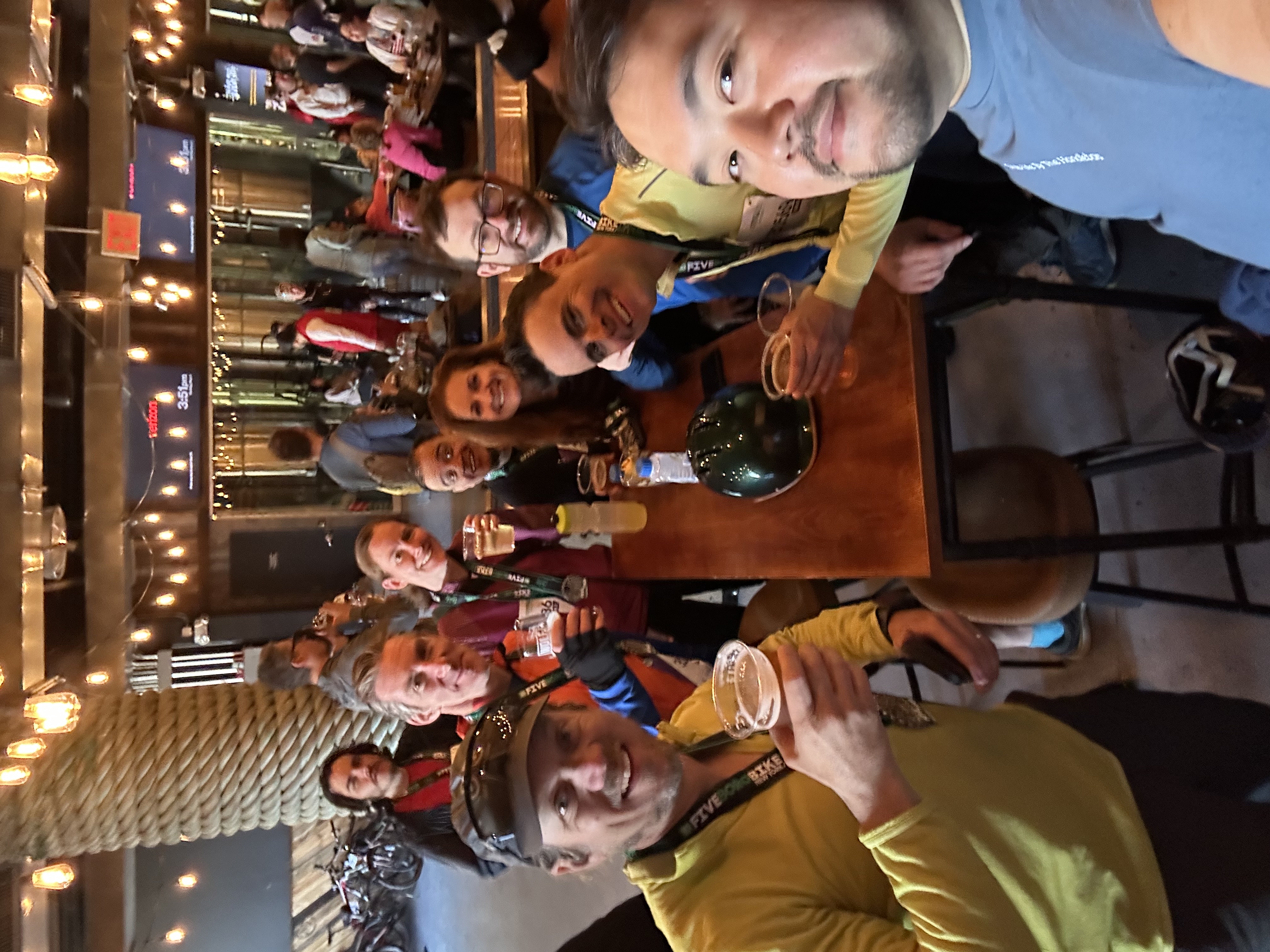
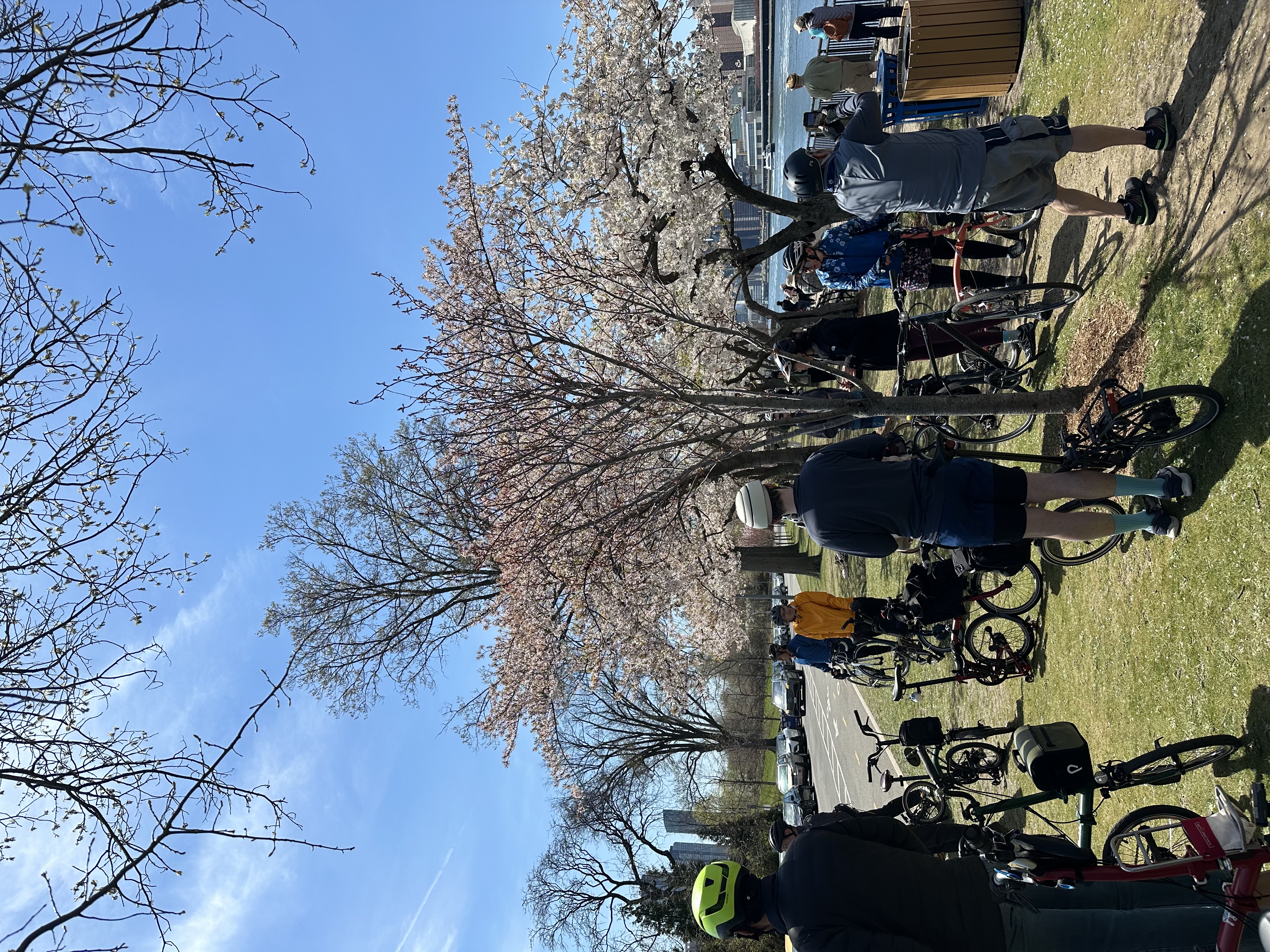
Meetups · the offline echo.
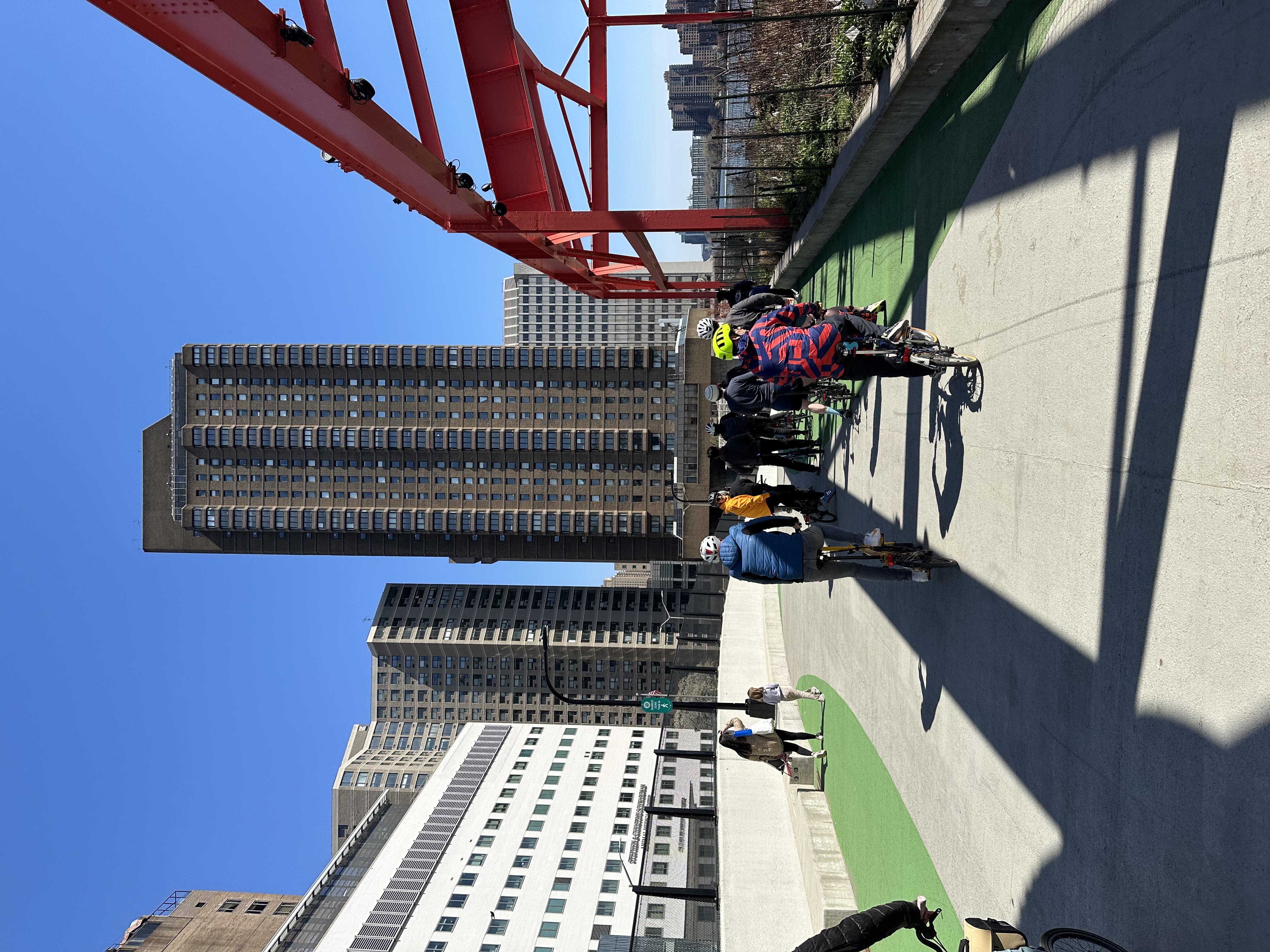
Full VoltHop case study — peer-to-peer battery rental, pre-build validation → VoltHop page
Three things both projects told me — once I stopped trying to make them say the same thing.
Find where the audience already is.
Don't import the audience to your channel — show up where they're already gathered. POMEs gathered in elevators. VoltHop gathered in r/Brompton. Both are pre-existing rooms; neither was built for me.
Match motion to medium.
Physical concentration → physical channels won. Digital concentration → digital channels won. When I cross-applied (POMEs Instagram, VoltHop leafletting) the response was flat. The medium has to fit the geometry.
Ask first, sell later.
Both projects' best learnings came from listening. The strongest VoltHop signal — a user coining the product name — happened in a thread that asked one question and made no pitch. The strongest POMEs signal — Tower 77's 10.2% — came after a one-line leaflet that posed a question, not a feature.
If I had to do this again tomorrow — start here.
- 01
Map the concentration first.
Before any channel touch, answer: where is the audience already gathered? Is it a physical room (one building, one event, one corridor), a digital room (subreddit, FB group, niche forum), or a chronological window (the moment a specific friction appears)? No answer here means no channel choice yet.
- 02
Match the motion to the geometry.
Physical concentration → physical occupation (leaflet, table, posters in the elevator). Digital concentration → posting + listening in the room itself, never adjacent. Resist the pull to default to whatever channel you're most comfortable with — the channel has to fit the geometry, not your habits.
- 03
Ship to learn, then optimize.
First touch is for signal, not conversion. A leaflet in one building, a single post in one subreddit. Read the response before scaling. POMEs scaled the elevator after Tower 77 hit 10.2%; VoltHop kept posting in r/Brompton after the attachment finding landed. Optimizing the wrong channel is the most expensive mistake.
What I’d change next: budget time for “Phase 0” — observation only — before any channel touch. Both projects’ best learnings came from listening, not selling.